
Living Inside the Case: Anxiety, the Nervous System, and Finding Ground When Everything Is Uncertain
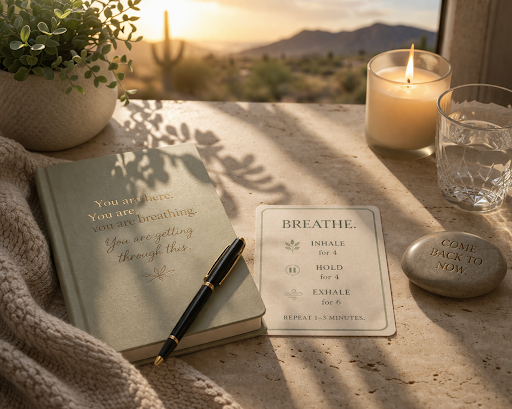
When you are facing a criminal case, the hardest part is often not the courtroom — it is what is happening inside you. This is about that. And about what can help.
By Janeth Nuñez del Prado, LCSW
Desert Bloom Psychology & Consulting
This piece is for anyone navigating a criminal case — as a defendant, a family member, or someone sitting beside a person they love while the legal process moves slowly around them.
When the case follows you home
I met Alicia on a Tuesday morning.
She looked like she hadn't slept in days. Her body was restless before she even sat down. When she did, I handed her a sensory bin — something textured to hold — and without hesitating, she picked up a fidget and began to move it through her fingers as she talked.
Alicia was facing serious criminal charges. Accusations she said were false, from a relationship that had ended badly.
But what struck me most wasn't the legal situation itself. It was what was happening inside her.
She couldn't stop thinking about what might happen next. Worst-case scenarios playing on a loop she couldn't turn off. Her appetite was gone. Her chest was tight. Her stomach was in knots. She felt disconnected from everyone around her — like she was present in the room but living somewhere else entirely.
In many ways, Alicia wasn't just facing criminal charges.
She was living inside them.
What uncertainty does to the body
When we are faced with serious uncertainty — especially the kind that involves legal systems, public exposure, and outcomes we cannot control — the nervous system responds as if the threat is constant. Because, in a way, it is.
The mind tries to protect us by imagining the worst. This is not a flaw. It is an ancient survival mechanism — one that helped our ancestors prepare for danger. But in the context of a pending legal case, that same mechanism can become its own kind of suffering. Instead of preparing us, it traps us. We begin to rehearse the worst possible outcome, over and over, long before anything has actually happened.
This shows up in the body as tight muscles, shallow breathing, racing thoughts, a constant scanning for the next threat. And when the body is in that state, we lose access to the very things that help us move through difficulty — clarity, connection, presence, and even brief moments of rest.
This matters beyond personal wellbeing. When anxiety is this consuming, it affects a person's ability to think clearly, communicate with their attorney, make decisions, and fully participate in their own defense. The emotional weight of a case is not separate from the legal work. It is part of it.
For many people, what surfaces during a criminal case is also layered onto older experiences — earlier trauma, histories of loss, or what the body already carries from encounters with systems that were not designed to protect them. That history does not disappear when a new crisis arrives. It arrives with it.
Who carries this differently - And why it matters
For families of color, immigrant families, and those who carry the weight of systemic oppression across generations, contact with the legal system does not feel like an isolated event. It arrives inside a longer story.
A story that may include mistrust of institutions earned over time. Experiences of criminalization that had nothing to do with wrongdoing. A cultural inheritance of silence that developed, across generations, as a form of survival and protection.
In those families, the anxiety is not only about what might happen in the courtroom. It is about what has already happened — to them, to their parents, to their grandparents — in rooms that looked a lot like this one.
If this is part of your experience, it deserves to be named. Not as a complication to work around, but as something real that belongs in the room when we talk about healing.
What cannot be taken from you
When everything feels uncertain, I often bring clients back to something simple.
What is true right now?
Right now — you are here. You are breathing. You still have the capacity to create moments of connection, meaning, and even brief relief. The outcome of the case is not yet written. And in the space between now and then, there is still a life being lived.
Viktor Frankl, writing from inside a Nazi concentration camp, observed that even in the most extreme conditions of suffering, a person retains the freedom to choose their own inner orientation. That the last human freedom — the one that cannot be taken — is the ability to choose how we meet what is happening to us.
You may not be able to control the outcome of your case. But you are not without agency in how you move through it.
Returning to the body
When anxiety spikes, we begin with the body. Not because the mind doesn't matter — but because the nervous system cannot be reasoned with. It responds to sensation, to breath, to presence. Not to argument.
When you feel yourself pulled into the loop of worst-case thinking, try naming five things you can see, four you can touch, three you can hear, two you can smell, one you can taste. It sounds small. It works because it interrupts the mind's pull toward the imagined future and returns you, gently, to where you actually are.
Breath is one of the few things in the nervous system we can influence directly. A slow exhale — longer than the inhale — begins to shift the body out of threat response. Inhale for a count of four, hold for four, exhale for six. Repeat until your shoulders soften. Until your jaw unclenches. Until the next five minutes feel manageable.
Sensory anchors — something textured to hold, something cold, something that carries a scent you associate with safety — remind the body that it is here, now. Not inside the worst-case scenario. Here.
Music you love, especially music that carries memory, can reach parts of the nervous system that words cannot. Your body remembers joy. It does not forget it entirely, even in the middle of this.
Connection as protection
One of the quieter cruelties of a legal situation is the isolation it tends to produce. Shame and fear push people inward and away — from friends, from family, from the ordinary moments of being known by someone.
And yet connection is one of the most powerful protective factors we have. Not fixing. Not advice. Simply the presence of someone who has not disappeared.
Notice who has shown up for you. Let yourself lean on safe people, even when it feels uncomfortable to need them. Allow support in. These moments are not distractions from what you are going through. They are part of how you survive it.
Small acts of care — for others and for yourself — matter more than they seem. Showing up for a friend. Noticing something beautiful. Writing down three things, however small, that were true and good today. These are not naive gestures. They are the practice of refusing to be entirely consumed.
What happened with Alicia
Over time, Alicia's situation did not resolve quickly. The legal process moved at its own pace, indifferent to her suffering.
But something inside her began to shift.
She started sleeping again. Eating again. Going back to the gym — not to change anything about how she looked, but to remember what her body could do. She reached out to people she had been avoiding. She allowed herself moments of calm without immediately feeling guilty for them.
The fear did not disappear. But it no longer consumed every hour.
That is the goal. Not the absence of difficulty. Not waiting until everything is resolved to begin living again. But movement — small, steady, real — back toward yourself.
A gentle invitation
If you are in the middle of this right now — or sitting beside someone who is — take a moment before you close this page.
Notice where you are holding tension in your body. Your jaw, your shoulders, your hands.
Take one slow breath. Not to fix anything. Just to arrive in this moment, exactly as it is.
You are still here. That is not nothing.
Whether you are navigating a legal situation, carrying the weight of uncertainty, or trying to stay present while everything feels suspended — you don't have to move through this alone. Reach out to schedule a private consultation.
*To protect privacy, names and identifying details have been changed. This piece reflects a composite of clinical experiences. It is intended for informational purposes and is not a substitute for individualized mental health care.