Where Law Meets Healing: NASW Presentation Resources for the Journey
Presented at the NASW New Mexico Annual Chapter Conference, By Janeth Nuñez del Prado, LCSW | Desert Bloom Psychology & Consulting.
Vignette 1 Miguel: More than a charge
Miguel was a man in his early twenties charged with a serious trafficking offense. He had been pulled over by police and was found to have a significant amount of drugs in his vehicle. The attorneys asked me to meet with him to assess what role social work could play in supporting him through the case.
Did he need therapy?
Were there mitigating factors that deserved attention?
What referrals or services might be helpful?
When I first met Miguel, he told me he had never spoken with a social worker before. He said he did not really believe in mental health treatment. In his view, guys should just "man up."
I told him those beliefs were common in many communities, including the Hispanic community I grew up in, and that I understood where they came from.
I asked him to tell me about what had happened. After hearing a brief version of the events, I asked him directly why he had been selling drugs.
"To get money," he said.
As we talked further, a larger story emerged. Miguel was raising a young child. His mother was unable to work. He wanted to provide for both of them.
I asked him what life had been like growing up.
He told me he never knew his father. His mother struggled to meet the family's basic needs. He remembered going to school in worn-out clothes. One memory stood out: showing up in a pair of hand-me-down Air Jordans and being made fun of and bullied by other kids.
He said “I never want my kid to feel what I felt standing in those shoes.”
I reflected back what I was hearing: that he loved his family deeply, that he was trying hard to provide for them, and that the path he chose ultimately caused harm.
He agreed.
Miguel shared that this experience had led him back to his faith. He believed everything happens for a reason.
I asked him what reason he thought this experience might serve.
He told me that he had become increasingly successful in trafficking. In his words, he was "getting really big." As his involvement grew, so did the risks. He recognized that his life was increasingly in danger. The possibility of not being there for his child had become very real.
I said, “This feels like an opportunity for growth. A chance to think about the values that mattered to you most and how you might build a life that aligns with those values without placing yourself, your family, or others at risk.
He nodded.
I explained that I could provide referrals for counseling if he felt they would be useful. We could also spend time together exploring how his past experiences influenced his present choices and what kind of future he wanted to create moving forward. I told him I would write a report for his attorneys and that, together, we could review it to ensure it accurately reflected his story before it was shared.
His response stayed with me.
"They're making a lot of assumptions about me. I want them to know that’s not who I am.”
At the end of our meeting, I asked him how the session had felt. How he felt about continuing to meet with me.
He paused and smiled.
"Honestly," he said, "it wasn't bad. It felt pretty good. I'm surprised."
Then he asked:
"When can we meet again?"
Vignette 2: A Parking Lot Disaster
A man in his late 30s, we’ll call him “Tony,” was referred to our law firm after being arrested following an altercation. On Monday, his elderly mother “Magda” reached out on his behalf — she had no prior experience with the criminal legal system.
Magda said that the day prior, Tony was arrested in front of his 16 year old daughter. He was alleged to have had a verbal altercation with another man over a Costco parking space. Tony was alleged to have brandished a firearm. No shots were fired. No one was physically injured. He had no prior history of violence. He was charged with felony assault with a deadly weapon. She said that court was tomorrow, she wasn’t sure what was going on but she knew Tony needed an attorney.
I scheduled her to come into the office the same afternoon and meet with the attorney and I. During the meeting, Magda and Tony’s daughter described a long history of significant mental health symptoms, inconsistent treatment engagement, and periods of emotional instability that had worsened over the previous several months. Tony’s daughter, though only 16, spoke with striking clarity and detail about her father’s treatment history, current medications, and the gaps in his care — a precocious knowledge that quietly named the weight she had been carrying.
The family reported that Tony had attempted on multiple occasions to seek support through community behavioral health systems but encountered fragmented care, difficulty maintaining consistent medication access, and inconsistent follow-up. His mother reported increasing concern about Tony’s emotional state in the weeks leading up to the incident. At the time of referral, Tony had been held in custody for two days without access to his psychiatric medication. His mother reported that he had not slept in three days and was deteriorating, saying that he was hearing voices that he knew weren’t there.
Court was the following morning at 9am. The District Attorney would be moving for pretrial detention — arguing that Tony posed a danger to the community and that no conditions of release could adequately mitigate public safety concerns. The judge would be asked to rule on whether Tony could be released before trial, or whether he would remain incarcerated until his case was resolved, which could be months or even a year.
My role in the hours before court was to develop a concrete clinical plan — one that could demonstrate to the judge that conditions existed in the community that would mitigate risk, stabilize Tony, and keep him connected to care. The plan had to be credible, specific, and ready to present by 9am. I wasn’t able to talk to Tony as he was in MDC with no access to receiving phone calls. The attorney would have some time right before court to meet with the client and get consent for the plan.
The clock was running.
Small Group Discussion Questions: Tony
1. Prioritizing:
Looking at Tony's presentation, the legal timeline, what immediate clinical priorities emerge for you?
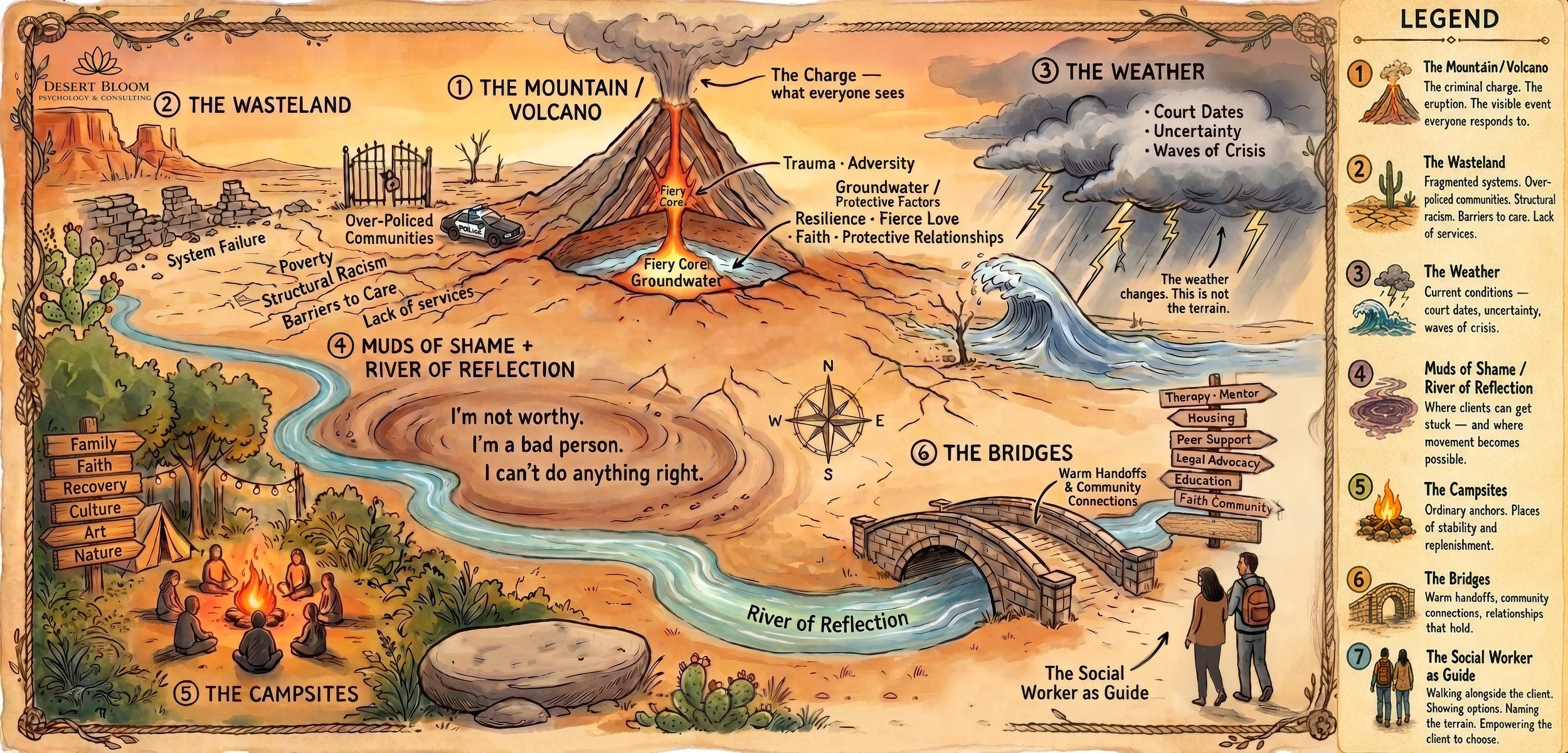
2. Water under the mountain: What strengths and protective factors do you see alongside the risks?
3. The Drought: What are the risk factors you see in the client?
3. The Plan: What would you do? Based only on the information in front of you — knowing that court is tomorrow morning at 9am and that the DA is moving for pretrial detention — what is your plan? What does the next 24 hours look like?
4. Systems: Where did the system fail? Where do you see gaps, barriers, or failures in the systems Tony encountered before this moment? What might have changed the trajectory?
5. The Model: What does embedded social work make possible? What could an embedded social worker do in this situation that traditional outpatient therapy could not? What becomes possible when law and healing share the same table?
6. Reflective Practice: What did this bring up in you? What internal responses, urges, or reactions arose as you read Tony's story? Did you notice any pull to rescue, fix, withdraw, or create certainty quickly? What might those reactions tell you about this work — and about yourself as a clinician? And where might you turn for support — who do you reach out to, and what does that look like for you?
All client material has been deidentified