
When Your Mind Knows, But Your Body Doesn't
By Janeth Nuñez del Prado, LCSW | Desert Bloom Psychology & Consulting.

There are moments in life when something happens that your mind can understand but your body and soul do not.
You can explain it. You can say the words out loud. You can even believe them at least in your head.
And still, your body lives a completely different story.
Because trauma doesn't happen in a vacuum. Our bodies don't just carry what has happened in a single moment or event. They also carry histories that are older and deeper intergenerational stress, migration stories, systemic oppression, racialized experiences. Sometimes what we feel in our bodies is not only about this moment but about everything our bodies have learned to hold over time.
BEFORE
There was a time in my life when everything felt complete.
I had two beautiful children, a supportive partner, and a life that was meaningful and grounded. When the idea of expanding our family came up again, it didn't feel like something was missing but like more joy and life in our home was possible, and we welcomed it in.
When I became pregnant, it happened quickly. Just like before. I had the usual thoughts what if something goes wrong? But underneath that was a quiet confidence. My body had done this before. Everything felt steady.
We began to make space for her in our home. We gave her a name. We chose the colors for her nursery. We held her in our hearts long before we held her in our arms.

THE MOMENT OF KNOWING
The morning of the ultrasound, I sat in the waiting room with my husband with a kind of nervous excitement. I couldn't wait to see her her small body, moving, alive on the screen.
But the moment the ultrasound began, something inside me shifted.
"Before anyone said anything, I knew. I looked at the screen and felt it in my body: something is wrong."
"Where is she?" I asked.
That moment didn't make sense and didn't feel real. It didn't match the hope and expectation I had been feeling. It didn't match what I believed to be true.
And yet - it was.
WHEN YOUR MIND UPDATES BUT YOUR BODY DOESN’T
Afterward, I was told what had happened. I was told it wasn't my fault. I was told there was nothing I could have done to prevent it.
And over time, I came to understand that logically.
But my body did not believe it.
I found myself searching for reasons. Was it something I did? Something I didn't do? A moment I got wrong? Even when I "knew" the answer, my body held on to something else — something deeper, more visceral and painful.
At times, I felt profoundly disconnected from myself. I would look at my body and not recognize it in the same way. There were moments it felt like a place that had failed. Failed me and failed my family.
My body is a graveyard.
That thought came. And it stayed for a while.
WHERE HEALING BEGAN
And yet this is also the place where my healing began.
Not in convincing myself of something new. Not in changing my negative thoughts or creating ones that were more balanced. My healing didn't come from thinking more positively or even more realistically.
It came from slowly, gently returning to my body.
It came from new pleasurable experiences. From sensations of feeling fully present with myself. From reconnecting with the parts of myself that existed beyond words.
I started small. I exposed my body to contrast cold and heat and felt the intensity of being alive in a way that surprised me. I returned to movement. Not to change how my body looked but to remember what it could do. I felt strength again. And began, slowly, to tell myself: my body is strong.
There were moments of quiet reconnection. Feeling the sun on my skin. Walking outside and noticing my breath. Letting my body move through water without needing it to be anything different.
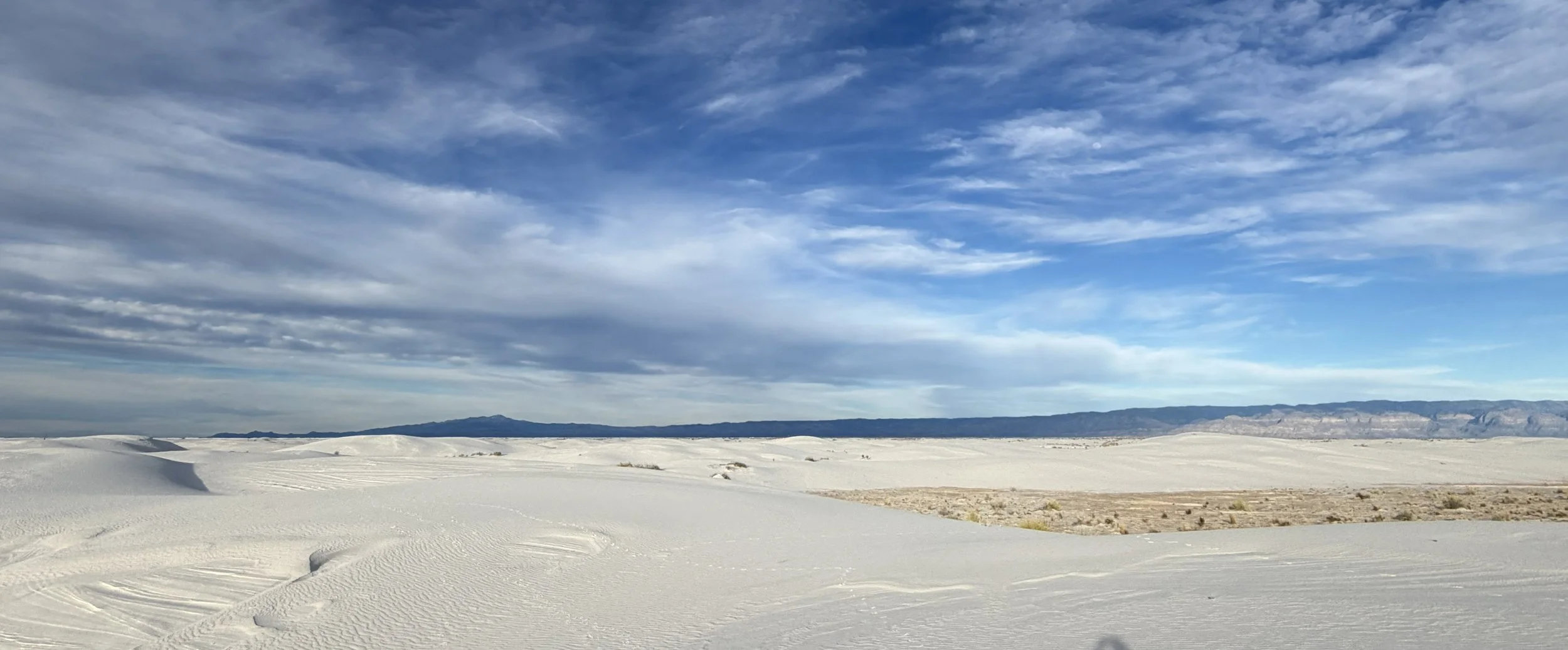
One day, I found myself standing barefoot in the sand, surrounded by the open New Mexican sky. There was nothing around me just space, light, and the feeling of the ground beneath my feet. For a moment, I stepped outside of the story in my mind and into something larger. Something that reminded me that life exists in many forms, in many ways, beyond what we can fully understand.
I also returned to practices that honored where I come from. Spaces where healing is not just individual but relational, cultural, and embodied. Where grief is not something to fix, but something to move through with support from friends and community, with presence, with care.
In one of those moments, I was reminded of something that stayed with me: that sometimes, guilt can feel easier than powerlessness. Because if something was our fault, then we can maintain the illusion that we had control. And if we had control then maybe we could have prevented this pain from happening.
But not everything works that way.
JUST AS TRAUMA LIVES IN THE BODY SO DOES HEALING TOO
What helped me was not forcing myself to move on, or holding tightly to the belief that time heals all. I realized it isn't just time it's what happens in that time.
It was allowing myself to reconnect with the full range of what my body could feel. Warmth. Strength. Breath. Connection. Pleasure. Even moments of peace.
Not all at once. Not perfectly. But gradually. Poco a poco.
My healing is ongoing. There are still moments that catch me off guard, when I feel the pain in my chest. Still waves of grief that come and go. But something inside me has shifted.
I no longer see my body as a place that failed me.
I see it as a place that has held life. That continues to hold life. A place that carries both grief and strength. Loss and connection. Pain and the capacity to feel alive again.

A GENTLE INVITATION
If you've ever found yourself in that space where you know something is true, but your body hasn't caught up yet you are not alone. There is nothing wrong with you.
You may not need more explanation. You may need embodied safety and reconnection.
Because healing isn't just about understanding what happened. It's about slowly, gently, learning how to feel again.
Consider this: what is one small way you can reconnect with your body today? Not to fix it. Not to change it. Just to feel it safely.
Taking three slow, intentional breaths before opening a difficult email. Stepping outside for two minutes to notice your feet on the ground. Letting your shoulders drop and soften, just noticing what happens inside.
Whether you are in the middle of a case, a victim of crime, or an attorney or high-responsibility professional carrying others' trauma we can work together to help your body catch up to what your mind already knows, and to find a way forward that feels more grounded and more fully alive.
Your body has held a lot. You don't have to carry it alone.
Reach out to schedule a private consultation.
