
The Cartography of Justice-Involvement
Where Law Meets Healing: Embedded Psycholegal Social Work Practice
Trauma · Criminal Justice · Motivational Interviewing · Social Work
Next public training date to be announced. Check back for upcoming dates or explore our scheduled trainings.
About This Training
What becomes possible when law and healing share the same table?
A criminal charge tells us something about an alleged act. It tells us very little about the person standing behind it—their history, their relationships, the systems they have encountered, or the strengths they carry.
The Cartography of Justice-Involvement offers a way to see the larger landscape.
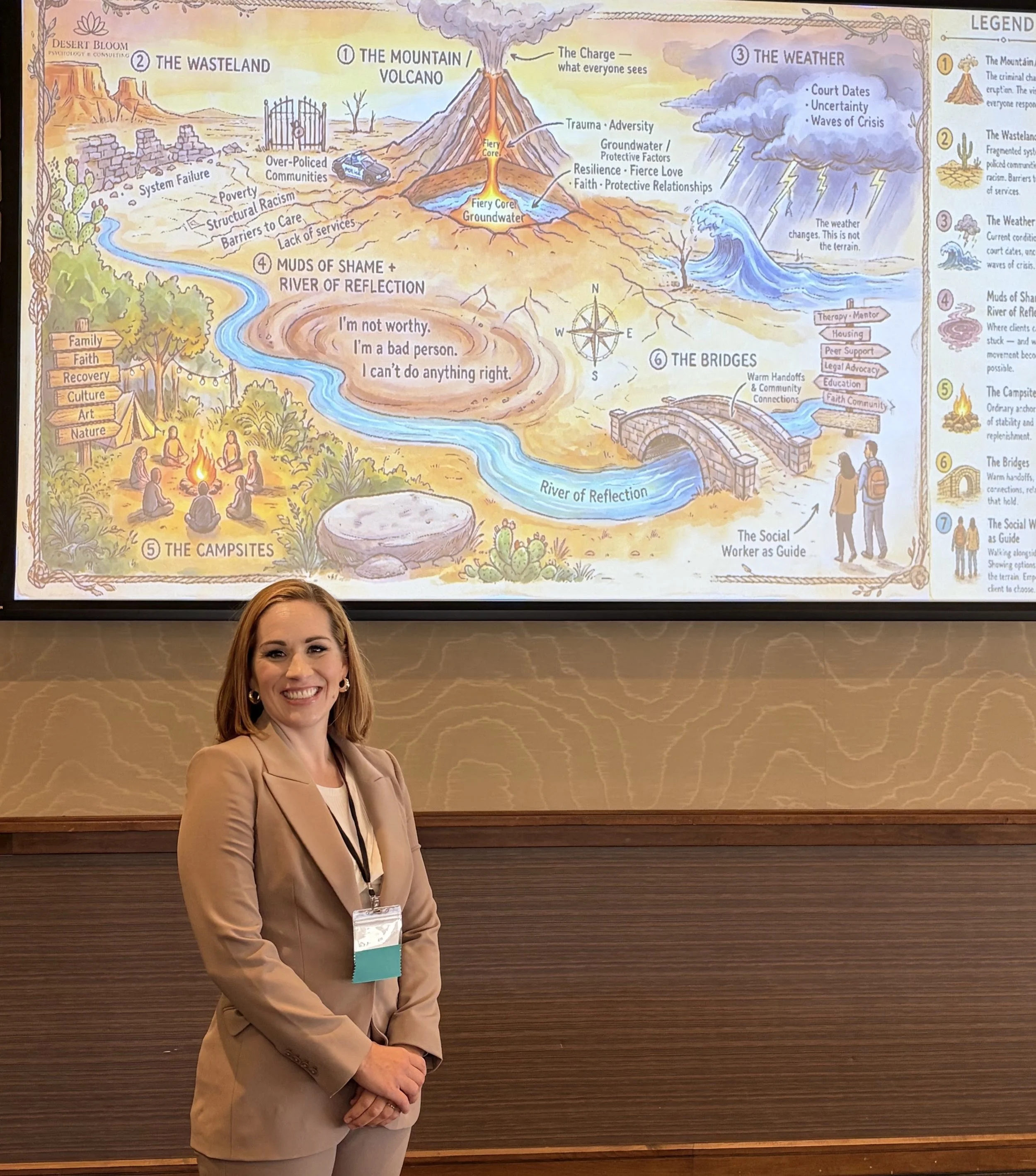
Developed through my work as an embedded clinical social worker at Max Pines Law, a criminal defense and civil rights law firm in Albuquerque, New Mexico, this framework uses the metaphor of a landscape to explore the complex terrain that justice-involved individuals and their families must navigate.
The mountain represents the criminal charge—the visible eruption of circumstances that may have been building for years. Beneath the mountain lies a fiery core of unresolved trauma, adversity, and suffering. But there is also groundwater: protective relationships, cultural roots, faith, love, and internal resources that may remain unseen.
Surrounding the mountain is the wasteland—fragmented systems, poverty, structural racism, barriers to treatment, and communities that have experienced generations of over-policing and underinvestment.
Within this landscape are the muds of shame, where people may become trapped in beliefs about their own worth, and the rivers of reflection, where insight, accountability, and movement become possible. There are also campsites—the ordinary relationships, routines, and experiences that help people remain connected to themselves and their values during periods of crisis.
The map invites us to look beyond symptoms, diagnoses, and legal charges without minimizing accountability or harm.
Embedded Psycholegal Social Work Practice
This training also introduces Embedded Psycholegal Social Work Practice, an approach that integrates clinical social work directly into legal representation.
Rather than functioning as an outside referral source, the embedded social worker participates alongside the legal team, providing psychosocial assessment, clinical support, mitigation, family engagement, attorney consultation, and connections to community resources.
The approach is organized around seven fidelity strands:
Contextual Fidelity
Relational Fidelity and the Spirit of Motivational Interviewing
Reflective Practice
Psycholegal Attunement
Community and Systems Integration
Cultural Humility
Embedded Role Fidelity
These strands serve as a compass rather than a checklist. They help practitioners maintain a relational, ethical, and clinically grounded approach while navigating the competing demands of legal proceedings, client needs, public safety, and complex systems.
Learning Objectives
By the end of this training, participants will be able to:
Identify the psychological, relational, and systemic dimensions beneath and alongside a criminal charge.
Describe the core principles and clinical functions of Embedded Psycholegal Social Work Practice.
Apply the principles of Embedded Psycholegal Social Work Practice to a de-identified case vignette, using clinical reasoning, strengths-based assessment, and reflective practice.
Learning Through Real Cases
Throughout the training, participants encounter de-identified stories drawn from clinical practice within a criminal defense setting.
These cases invite participants to consider questions that rarely have simple answers:
How do we recognize a person's strengths while also taking risk and accountability seriously?
What happens when someone needs mental health treatment but the systems designed to provide it have repeatedly failed?
How can clinicians support individuals and families while respecting the legal process, confidentiality, and professional boundaries?
What reactions arise in us when we work with people accused of causing harm?
How might legal advocacy and clinical support work together to create opportunities that neither could offer alone?
Participants are invited to step into the role of an embedded social worker, examine competing priorities, and develop practical responses to complex clinical and legal situations.
Who Should Attend?
This training is designed for clinical social workers, therapists, counselors, case managers, mitigation specialists, legal professionals, and others who work with justice-involved individuals and their families.
It may be particularly relevant for professionals working in criminal defense, community mental health, forensic settings, substance use treatment, crisis services, and programs serving individuals affected by incarceration.
Training Availability
Next public training date to be announced.
This training was presented at the NASW New Mexico Annual Chapter Conference on June 17, 2026.
Available for organizational inquiries and professional team trainings. Content and length may be adapted to the needs of your group.
Contact Desert Bloom Psychology & Consulting to inquire about scheduling a training.
WHAT PARTICIPANTS ARE SAYING
“Janeth’s training was engaging, meaningful, and immediately applicable—I left with real tools for my clients and supervisees and can’t wait to train with her again.”
"This work is so original and so inspired!"
"I loved her energy and the passion she brought when she was speaking. I also appreciated the knowledge and group activities to assist with engagement."
"Phenomenal - we need more like this! Highly engaging presenter."
"I really enjoyed the visuals. Her passion came through and her presentation was well organized."
"I loved her use of storytelling and her case examples drawn from her own work."
"Loved the metaphor and visualization."
“The presentation was informative and a great experience. It is impactful to see how passionate she is about what she does."
"Overall amazing. Very engaging. Very informative. Left a long-lasting impact."
